
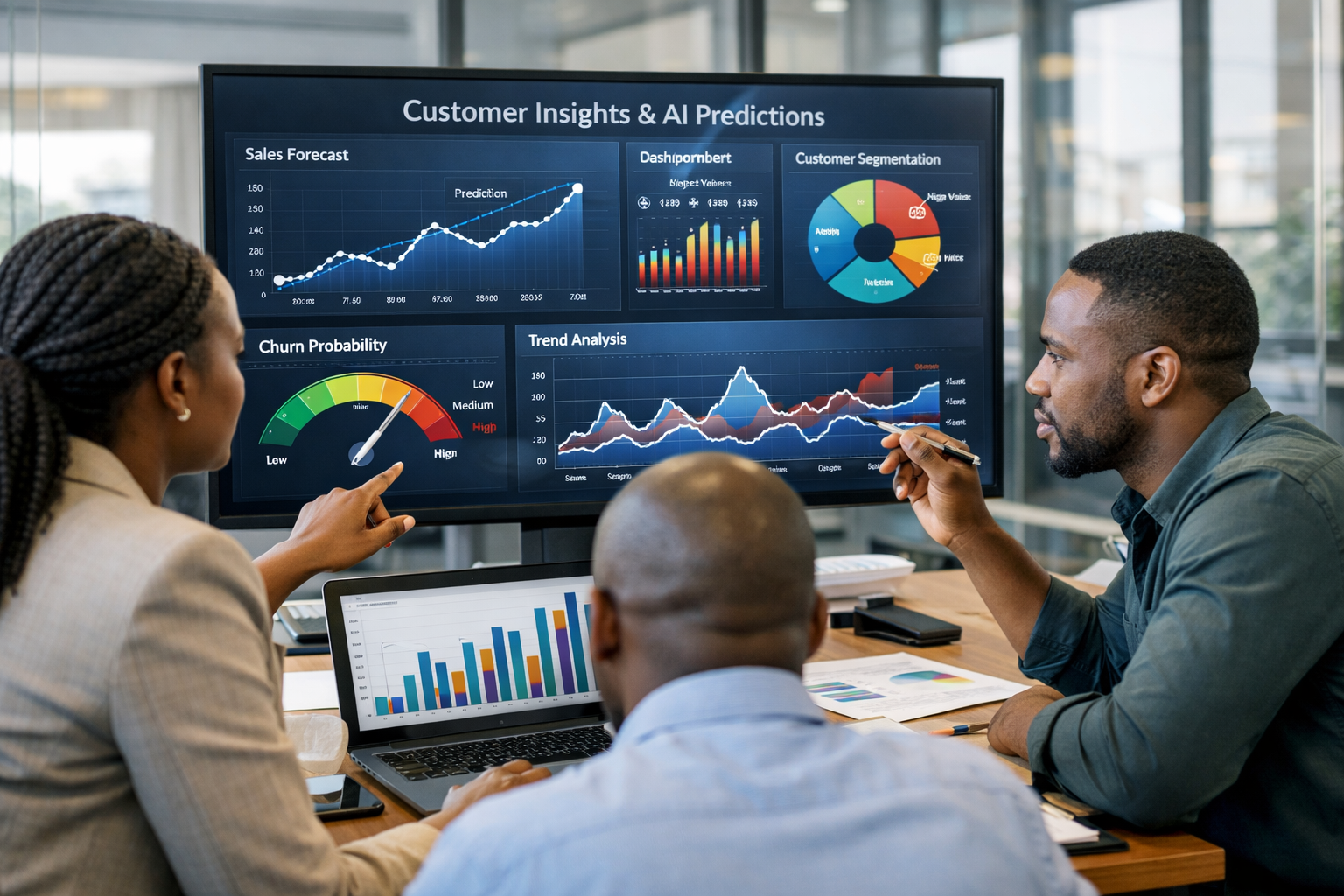
Understanding customer behavior has always been a key advantage in business. In 2025, artificial intelligence is taking this to a new level. Instead of relying solely on historical data and assumptions, companies can now predict what customers are likely to do next — with remarkable accuracy.
From personalized recommendations to demand forecasting, AI-powered prediction is reshaping how brands engage, convert, and retain customers.
1. What Does Predicting Customer Behavior Mean?
Predicting customer behavior involves using data to anticipate future actions, such as:
- What a customer might purchase next
- When they are likely to churn
- Which marketing message they will respond to
- How much they are willing to spend
- Which channel they prefer
AI enables businesses to move from reactive decisions to proactive, data-driven strategies.

2. How AI Predicts Customer Behavior
AI systems analyze large volumes of data and identify patterns that humans might miss.
Common data sources include:
- Website interactions
- Purchase history
- Search behavior
- Social media engagement
- Email responses
- Customer support interactions
Using machine learning algorithms, AI detects trends, correlations, and anomalies to generate predictions in real time.
3. Key AI Techniques Used
Several AI and machine learning methods power customer behavior prediction:
a. Machine Learning Models
Algorithms learn from historical data to forecast future outcomes, such as purchase likelihood or churn risk.
b. Predictive Analytics
Statistical models combined with AI estimate probabilities and future behaviors based on past patterns.
c. Natural Language Processing (NLP)
NLP analyzes customer reviews, chats, and feedback to understand sentiment and intent.
d. Recommendation Engines
AI suggests products or content based on similar user behaviors and preferences.
4. Practical Use Cases for Businesses
AI-driven behavior prediction is already widely used across industries.
E-commerce
- Personalized product recommendations
- Cart abandonment prediction
- Dynamic pricing
Marketing
- Customer segmentation
- Campaign performance forecasting
- Personalized messaging
Customer Retention
- Churn prediction
- Loyalty optimization
- Targeted retention offers
Sales
- Lead scoring
- Purchase timing prediction
- Upsell and cross-sell opportunities
5. Benefits of Using AI for Customer Prediction
Businesses that leverage AI gain measurable advantages:
- Higher conversion rates
- Improved customer experience
- Reduced churn
- More efficient marketing spend
- Faster decision-making
Predictive insights allow brands to act before customers disengage.

6. Tools and Platforms Commonly Used
Popular AI-powered tools include:
- Customer Data Platforms (CDPs)
- CRM systems with AI features
- Predictive analytics software
- AI-powered marketing automation tools
Many platforms integrate seamlessly with existing data systems, making adoption more accessible.
7. Ethical Considerations and Data Privacy
While AI prediction is powerful, it must be used responsibly.
Key considerations:
- Transparent data collection
- User consent and compliance with regulations
- Avoiding algorithmic bias
- Protecting sensitive customer data
Trust is essential — predictive accuracy should never come at the cost of customer privacy.
8. How to Get Started with AI Prediction
For businesses beginning their AI journey:
- Collect clean, high-quality data
- Define clear prediction goals
- Start with simple models
- Continuously test and refine predictions
- Align AI insights with human judgment
AI works best as a decision-support tool, not a replacement for strategic thinking.
Conclusion
AI-powered customer behavior prediction is no longer a luxury — it’s a competitive necessity. By understanding what customers are likely to do next, businesses can deliver more relevant experiences, reduce friction, and build long-term loyalty. When used ethically and strategically, AI transforms customer data into actionable foresight.
References (External Links)
- McKinsey – Using AI to Unlock Customer Insights
https://www.mckinsey.com - Harvard Business Review – Predictive Analytics and Customer Behavior
https://hbr.org - Forbes – How AI Is Transforming Customer Analytics
https://www.forbes.com - IBM – AI and Predictive Analytics for Business
https://www.ibm.com - Gartner – Customer Analytics and AI Trends
https://www.gartner.com