
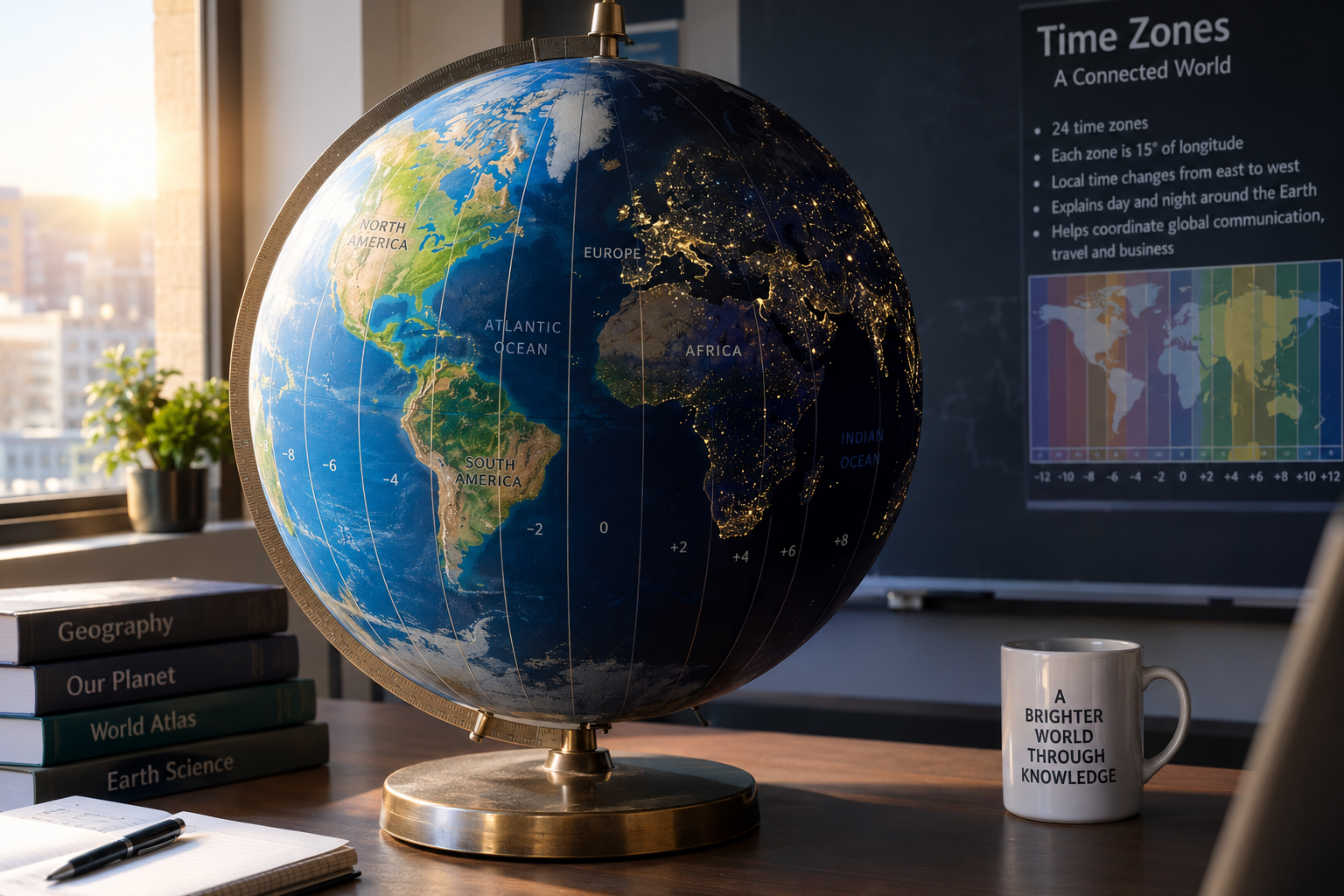
Time is something people around the world experience every day, but it does not occur at exactly the same hour everywhere on Earth. While one person may be starting their morning, another may be preparing for bed.
This difference exists because the Earth rotates on its axis, causing different parts of the planet to face the Sun at different times. To make this global difference easier to manage, humans created time zones.
Today, time zones influence everything from international travel and business meetings to online events, communication, transportation, and digital services. Understanding how they work helps explain why the same moment can have different clock times around the world.
1. What Is a Time Zone?
A time zone is a geographical region where people generally use the same standard time.
The world is divided into multiple time zones based primarily on the Earth’s rotation and its position relative to the Sun. Ideally, the planet can be divided into 24 major time zones because Earth completes approximately one rotation every 24 hours.
Each zone represents roughly one hour of difference from the next.
For example:
- Lagos operates on West Africa Time (WAT).
- London generally uses Greenwich Mean Time (GMT) or British Summer Time (BST), depending on the season.
- New York uses Eastern Time.
- Tokyo uses Japan Standard Time (JST).
However, real-world time zones do not always follow perfectly straight geographical lines because countries adjust their boundaries for political, economic, and practical reasons.
2. Why Does the World Need Time Zones?
Before modern transportation and communication, people mostly relied on local solar time. Noon was generally considered the time when the Sun was highest in the sky.
This worked reasonably well when people traveled slowly and communicated locally.
The situation changed dramatically with the development of railways and long-distance communication.
Imagine a train traveling between several cities. If every city used its own local solar time, railway schedules would become confusing because every location could have a slightly different time.
Standardized time became necessary.
Time zones helped create a consistent system that allowed people in different locations to coordinate activities more easily.

3. How the Earth’s Rotation Creates Different Times
The Earth rotates from west to east.
One complete rotation takes approximately 24 hours. During this rotation, different parts of the planet move into and out of sunlight.
This creates day and night.
As Earth rotates, locations farther east generally experience sunrise and daytime earlier than locations farther west.
This is why:
- Morning arrives earlier in eastern regions.
- Afternoon occurs later in western regions.
- Night begins at different times around the planet.
Time zones are essentially a way of organizing these differences into a practical global clock system.
4. The Prime Meridian and Greenwich Mean Time
One of the most important concepts in understanding time zones is the Prime Meridian.
The Prime Meridian is the reference line at 0 degrees longitude. It passes through Greenwich in London, England.
For many years, Greenwich Mean Time (GMT) served as an important international reference for calculating differences between time zones.
For example, a location one hour ahead of GMT would generally be described as GMT+1, while a location two hours behind would be GMT-2.
Today, the world’s technical timekeeping system primarily uses Coordinated Universal Time (UTC) as its reference.
5. What Is UTC?
UTC stands for Coordinated Universal Time.
It serves as the primary international reference for civil timekeeping and is used by computers, telecommunications systems, aviation, scientific organizations, and many other industries.
Time zones are commonly expressed as offsets from UTC.
For example:
- UTC+1 means one hour ahead of UTC.
- UTC+5 means five hours ahead.
- UTC-5 means five hours behind.
- UTC+0 means the same clock time as UTC.
Nigeria, for example, uses West Africa Time, which is UTC+1 throughout the year.
6. Why Time Zones Are Not Perfectly Straight Lines
If time zones were based entirely on longitude, they would form relatively straight lines around the Earth.
In reality, they often look irregular on maps.
This happens because countries establish time-zone boundaries according to political borders, economic relationships, geography, and practical considerations.
A country may decide to use a particular time even if another theoretical time zone would align more closely with its longitude.
This makes time zones a combination of astronomy, geography, politics, and human convenience.
7. What Is Daylight Saving Time?
Some countries adjust their clocks during part of the year through a system known as Daylight Saving Time (DST).
Typically, clocks are moved forward by one hour during a particular season and moved back later in the year.
The idea is to make better use of daylight during the evening.
However, not every country uses daylight saving time.
For example, Nigeria does not currently change its clocks seasonally. Other countries, including the United States and many European countries, have historically used seasonal clock changes.
This means that the time difference between two locations can sometimes change during the year.
8. Why Time Differences Matter for International Business
Time zones have become especially important because businesses can now operate across multiple countries.
A company based in Africa may have customers in Europe, employees in Asia, and business partners in North America.
Scheduling meetings therefore requires careful attention to time differences.
For example, a meeting scheduled for 10:00 a.m. in Lagos will not necessarily occur at 10:00 a.m. for participants in London, New York, or Tokyo.
Businesses use calendars, scheduling applications, and international time-zone databases to reduce confusion.
Clear communication about the time zone is particularly important when scheduling:
- Online meetings
- Webinars
- Product launches
- International interviews
- Customer support shifts
- Marketing campaigns
- Global events
9. Time Zones and International Travel
Traveling across time zones can make schedules confusing.
A flight may leave one country in the evening and arrive in another country the following morning, even if the actual journey lasts only a few hours.
Airlines therefore publish departure and arrival times according to the local time of each airport.
This is why travelers need to pay attention to the date and local time displayed on their tickets.
Time zones can also contribute to jet lag, which occurs when the body’s internal biological clock is temporarily out of alignment with the local time.
10. Why Some Countries Have Multiple Time Zones
Large countries can stretch across thousands of kilometers.
Because of their geographical size, different parts of the country may experience daylight at significantly different times.
Countries such as the United States, Canada, Russia, Australia, and Brazil therefore use multiple time zones.
This allows local clocks to better reflect the natural cycle of daylight.
A person traveling across one of these countries may need to adjust their clock several times.
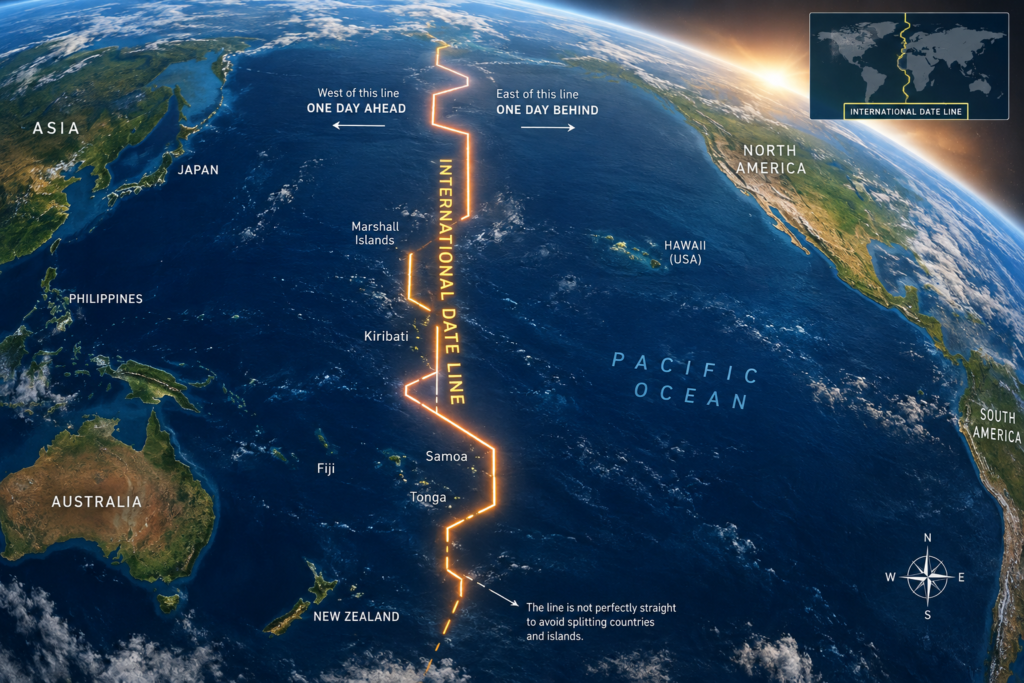
11. What Is the International Date Line?
The International Date Line is an imaginary line located roughly along the 180-degree longitude line in the Pacific Ocean.
It plays an important role in determining when the calendar date changes.
When travelers cross the International Date Line, the calendar date changes even though they may not have traveled for 24 hours.
The line does not follow a perfectly straight path because it has been adjusted to accommodate the territories and countries located around the Pacific Ocean.
This helps prevent individual countries and island groups from being split inconveniently between different calendar dates.
12. How Time Zones Affect Technology
Modern technology depends heavily on accurate timekeeping.
Computers and online systems need to know exactly when events occur.
Time zones influence:
- Email timestamps
- Online calendars
- Social media scheduling
- Banking transactions
- Website analytics
- E-commerce orders
- Software updates
- Flight information
- Video conferences
- Server operations
For example, an online event might be advertised as occurring at 6:00 p.m. in one location while attendees elsewhere see a different local time.
Modern applications therefore often convert UTC-based timestamps into the user’s local time automatically.
13. Why Time Zones Matter for Digital Marketing
Time zones are also important in digital marketing.
Publishing content at the right time can help businesses reach audiences when they are most active.
A company targeting customers in several countries may need to schedule social media posts, email campaigns, advertisements, and webinars according to different local times.
For example, an audience in West Africa may be online at different hours from an audience in North America or Asia.
Understanding time zones can therefore help marketers:
- Schedule campaigns more effectively.
- Send emails at appropriate local times.
- Coordinate international launches.
- Avoid sending notifications during inconvenient hours.
- Analyze traffic according to local audience behavior.
- Coordinate teams working across different regions.
Time-zone awareness becomes increasingly important as businesses expand beyond their local markets.

14. Why Time Zones Can Sometimes Be Confusing
Time zones are not always as simple as adding or subtracting one hour.
Several factors can affect the calculation.
These include:
- Daylight Saving Time
- Political decisions
- Changes to national time policies
- Half-hour time zones
- Quarter-hour time zones
- International Date Line changes
Some locations use offsets such as UTC+5:30 or UTC+5:45 rather than a whole number of hours.
This is why modern applications generally rely on standardized time-zone databases rather than simple manual calculations.
15. The Difference Between a Time Zone and a Time Offset
A time offset describes the difference between a local time and UTC.
A time zone, however, can include a broader set of rules about how time is observed in a particular location.
For example, two places might currently have the same UTC offset but have different rules about seasonal clock changes.
This distinction is important for software developers, businesses, airlines, and international organizations because the current offset alone may not tell the complete story.
16. The Importance of Standardized Time
Standardized time has made modern society much easier to coordinate.
Without standardized time zones, activities involving multiple locations would become significantly more complicated.
Consider how difficult it would be to coordinate:
- International flights
- Global financial markets
- Internet services
- Television broadcasts
- Online meetings
- International sports competitions
- Global supply chains
- Remote work
Time zones provide a common framework that allows people around the world to organize their activities.
Conclusion
Time zones exist because the Earth rotates, causing different parts of the planet to experience daylight and darkness at different times.
What began as a practical solution to the challenges created by railways and long-distance communication has become an essential part of modern life.
Today, time zones influence everything from travel and international business to digital marketing, technology, communication, and global collaboration.
Understanding UTC, time offsets, daylight saving time, and the International Date Line makes it easier to understand why people in different parts of the world can experience different clock times while living through the exact same moment.
As the world becomes increasingly connected, understanding time zones is no longer just a geographical concept. It is an important part of communicating and working effectively in a global society.