

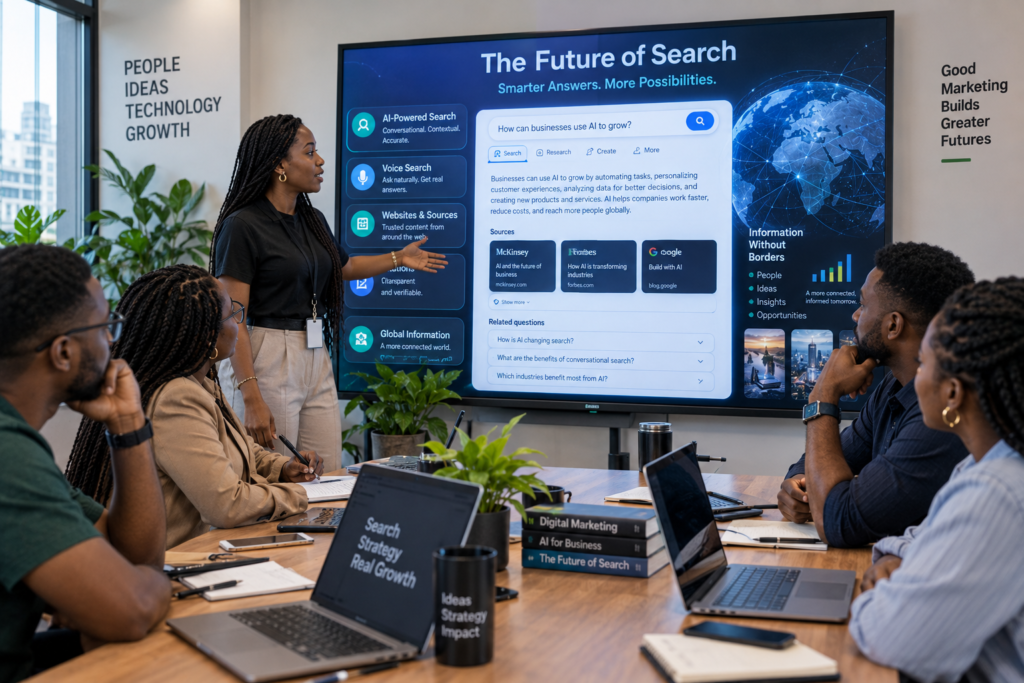
Search is becoming more conversational and increasingly powered by artificial intelligence. What was once known as Search Generative Experience (SGE) has evolved into Google’s current generative AI features, including AI Overviews and AI Mode.
These experiences can summarize information, answer complex questions, provide links to supporting sources, and allow users to continue searching through follow-up questions.
For marketers, this means traditional SEO strategies need to evolve alongside the way people search.
1. What Are Search Generative Experiences?
Search generative experiences use AI to provide more direct and conversational answers to search queries.
Instead of showing only a list of links, AI-powered search can combine information from different sources and present an overview of a topic.
This means users may get useful information before clicking on an individual website.
2. Search Intent Matters More Than Ever
AI-powered search is designed to understand the meaning behind a question.
Marketers should therefore focus on why people are searching, not just the keywords they type.
For example, instead of targeting only:
“digital marketing agency”
a business could create content answering:
“How can a small business use digital marketing to generate more customers?”
Understanding the customer’s actual problem can lead to more useful content.
3. Helpful Content Is Essential
AI search increases the importance of creating content that genuinely helps people.
Your content should:
- Answer questions clearly.
- Provide useful examples.
- Demonstrate expertise.
- Use reliable information.
- Avoid unnecessary repetition.
- Offer something beyond generic information.
Google’s current guidance continues to emphasize helpful, reliable, people-first content.

4. Original Information Can Set Your Brand Apart
As AI makes generic content easier to produce, original insights become increasingly valuable.
Marketers can strengthen their content through:
- Case studies
- Original research
- Expert opinions
- Customer experiences
- Industry data
- First-hand examples
For example, a marketing agency sharing the results of an actual campaign can provide more distinctive value than another generic article about “marketing tips.”
5. Traditional SEO Still Matters
AI search does not mean marketers should abandon SEO.
Google continues to recommend established SEO practices for visibility in its generative AI search experiences. Websites still need to be crawlable, technically sound, useful, and well-structured.
Important fundamentals include:
- Strong page titles and headings
- Internal linking
- Mobile-friendly design
- Fast loading times
- Clear website structure
- High-quality content
- Accurate and updated information
6. Build a Strong Digital Reputation
Marketers should think beyond individual webpages and consider the overall authority of their brand.
Make sure your website clearly communicates:
- What your business does
- Who you serve
- Your expertise
- Your products or services
- Your location
- How customers can contact you
A consistent and trustworthy online presence can make it easier for search systems and potential customers to understand your business.
7. Measure More Than Rankings
Traditional SEO reporting often focuses on rankings, impressions, clicks, and traffic.
As AI search develops, marketers also need to pay attention to how their content appears within AI-powered search experiences.
Google has introduced additional Search Console insights for generative AI search features, including information about pages appearing in AI responses and the countries where they appear.
This makes it increasingly important to evaluate visibility and brand discovery, not just traditional keyword rankings.
8. Avoid Creating Content Just for AI
The growth of AI search may tempt marketers to produce huge amounts of AI-generated content.
That can be a mistake.
Google specifically warns against scaled content created primarily to manipulate search rankings, including large amounts of unoriginal AI-generated content that provides little value.
AI can be useful for research, brainstorming, and productivity, but human expertise and meaningful value should remain at the center of the content strategy.
Conclusion
Search generative experiences are changing how people discover information and how brands compete for attention online.
For marketers, the key is not to chase every new AI trend. Instead, focus on the fundamentals: understand your audience, answer real questions, create original and useful content, maintain a strong website, and build genuine expertise.
The future of search is becoming more conversational, but the goal remains the same: help people find trustworthy information that solves their problems.