

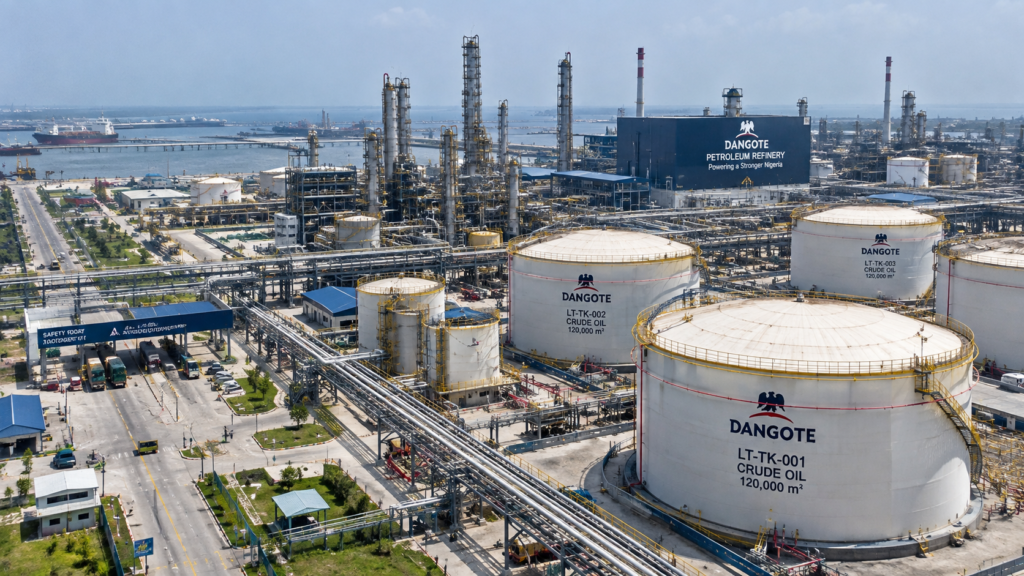
Nigeria’s capital market is entering a significant new chapter with the public offering of shares in the Dangote Petroleum Refinery & Petrochemicals.
Launched on September 14, 2026, the offering is being described as Africa’s largest initial public offering (IPO) to date. The refinery is offering 4.1 billion shares at ₦525 per share, with the aim of raising about ₦2.15 trillion, or approximately $1.6 billion.
But what exactly does this mean, and why is the Dangote IPO attracting so much attention?
1. What Is the Dangote IPO?
An IPO, or Initial Public Offering, is when a private company offers shares to the public for the first time.
In this case, investors are being given the opportunity to buy shares in Dangote Petroleum Refinery & Petrochemicals and potentially become shareholders in one of Africa’s largest industrial projects.
The shares are expected to be listed on the Nigerian Exchange (NGX).
2. How Much Is the IPO Worth?
The public offer consists of 4.1 billion ordinary shares priced at ₦525 each.
If fully subscribed, the offering would raise approximately ₦2.15 trillion.
The refinery’s implied valuation is around ₦63 trillion, equivalent to roughly $47.6 billion based on the exchange-rate calculation reported by Reuters.
This makes the transaction exceptionally large for Nigeria’s capital market.

3. Why Is Dangote Going Public?
One of the major reasons for the IPO is to raise capital for expansion.
Dangote plans to increase the refinery’s processing capacity significantly, with a target of reaching approximately 1.4 million barrels per day in the coming years.
The additional capital could help finance this expansion while giving public investors an opportunity to participate in the company’s future growth.
4. Why Is the IPO Important to Nigeria?
The refinery is already an important part of Nigeria’s energy sector.
Operating at around 700,000 barrels per day, the facility has helped reduce Nigeria’s dependence on imported refined petroleum products and has also begun supplying international markets.
A successful IPO could also deepen Nigeria’s capital market by bringing more individual investors into the stock market.
The offering has been promoted as a “people’s IPO,” with the goal of attracting retail investors as well as institutions.
5. How Much Do Investors Need to Start?
The minimum purchase is reported as 10 shares.
At ₦525 per share, 10 shares would cost ₦5,250, before any applicable charges.
This relatively low entry point is intended to make the offering accessible to ordinary investors rather than limiting participation to large institutions.
However, accessibility does not mean the investment is risk-free.
6. What Are the Potential Benefits?
For investors, owning shares could provide exposure to the future performance of a major Nigerian industrial company.
For Nigeria’s economy, a successful offering could:
- Increase participation in the capital market.
- Attract more retail investors.
- Support expansion of the refinery.
- Strengthen Nigeria’s energy industry.
- Increase activity on the Nigerian Exchange.
- Encourage future large-scale public offerings.
The broader significance is that a major Nigerian industrial business is opening part of its ownership to the public.
7. What Are the Risks?
Like any investment in shares, the Dangote IPO carries risks.
The share price can rise or fall after listing, and the company’s future performance may be affected by factors such as:
- Global oil prices
- Refining margins
- Exchange-rate movements
- Government policies
- Competition
- Expansion costs
- Changes in global energy demand
Investors should therefore avoid assuming that a well-known company automatically guarantees profits.
The Nigerian SEC specifically advises prospective investors to read the approved prospectus, understand the terms and risks, and use only officially approved subscription channels.
8. Why People Should Be Careful About Scams
The popularity of the IPO has already created opportunities for fraudsters.
The SEC has warned investors not to send money to individuals or unofficial platforms claiming to offer Dangote IPO shares or guaranteed allocations.
Investors should verify that their chosen broker, bank, or investment platform is authorized to participate in the offering.
This is particularly important because scammers often use popular investment opportunities to collect money from unsuspecting individuals.
Conclusion
The Dangote IPO represents a major moment for Nigeria’s capital market and one of the most significant public offerings in Africa.
Beyond the opportunity to invest in a major industrial project, the IPO could encourage greater participation in Nigeria’s stock market and provide additional capital for the refinery’s planned expansion.
However, potential investors should approach the opportunity carefully. A famous company is not the same thing as a guaranteed investment.
Anyone considering participating should study the official prospectus, understand the risks, and use only approved channels.
This article is for informational purposes and should not be considered financial or investment advice.
References
- Nigeria Securities and Exchange Commission – Dangote Petroleum Refinery IPO
- Nigerian Exchange Group – Dangote IPO Facts Behind the Offer
- Reuters – Facts About Nigeria’s Dangote Oil Refinery IPO
- Associated Press – Dangote Refinery Public Investment
- Reuters – Dangote Refinery IPO and Investor Appetite