
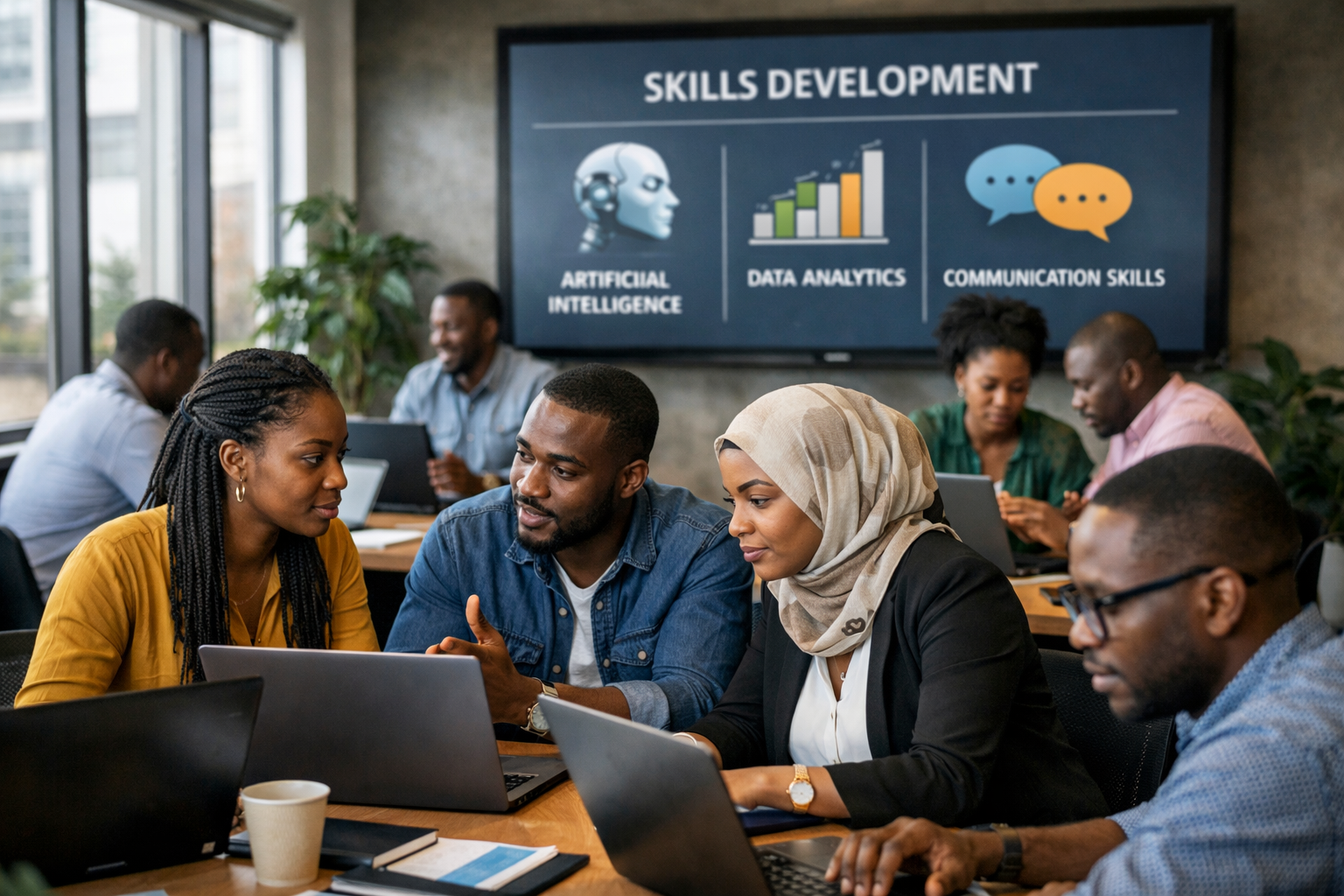
Introduction
The future of work is being shaped by artificial intelligence, automation, remote collaboration, and rapid digital transformation. As industries evolve, the most valuable professionals will not simply be those with technical knowledge, but those who combine human judgment, adaptability, and digital fluency.
Recent workforce research consistently shows that the demand is shifting away from static job-specific skills toward durable, transferable capabilities that remain useful even as tools change.
1. AI and Digital Fluency
AI is becoming part of everyday workflows across industries. From writing assistance to data analysis and automation, employees now need confidence using intelligent tools.
This includes:
- Understanding AI-powered tools
- Knowing when to trust or verify outputs
- Using automation platforms effectively
- Working comfortably with digital systems
AI literacy is quickly becoming as important as general computer literacy.

2. Critical Thinking and Judgment
As AI generates more information, human value shifts to interpretation and decision-making.
Future-ready professionals must be able to:
- Evaluate AI-generated recommendations
- Prioritize what matters
- Make decisions under uncertainty
- Apply context and ethical reasoning
Judgment is increasingly viewed as the premium skill that machines cannot easily replicate.
3. Adaptability and Learning Agility
Technology cycles are moving faster than ever. Many tools used today may become outdated in just a few years.
This makes adaptability essential.
Key behaviors include:
- Learning new systems quickly
- Unlearning outdated workflows
- Pivoting across changing roles
- Remaining open to experimentation
The professionals who thrive will be those who can continuously evolve with the workplace.
4. Communication and Storytelling
The ability to explain complex ideas clearly will remain highly valuable.
As AI produces data, reports, and drafts, humans must still:
- Translate insights into action
- Communicate with teams and stakeholders
- Lead cross-functional discussions
- Tell compelling stories with data
Strong communication turns information into influence.
5. Creativity and Problem Framing
AI can generate answers, but it still depends heavily on the quality of the question.
This is why problem framing and creativity matter deeply.
Future workers must be able to:
- Define the real problem
- Generate original solutions
- Connect unrelated ideas
- Innovate beyond templates
The more routine work becomes automated, the more originality becomes a competitive advantage.
6. Emotional Intelligence and Collaboration
As workplaces become hybrid and globally distributed, emotional intelligence is becoming central to leadership and teamwork.
This includes:
- Empathy
- Conflict resolution
- Cross-cultural communication
- Trust-building
- Team motivation
Human-centered collaboration skills will remain among the hardest to automate.
7. Systems Thinking
Modern work increasingly involves interconnected tools, teams, and workflows.
Systems thinking helps professionals:
- Understand cause and effect
- Map dependencies across processes
- Solve problems at scale
- Improve workflow design
People who can see how everything connects will be especially valuable in AI-enabled organizations.
8. Lifelong Learning as a Core Skill
Perhaps the most future-proof skill is the ability to keep learning.
In a fast-changing economy, success depends less on what you know now and more on how quickly you can gain new knowledge.
This means:
- Taking courses regularly
- Practicing new tools
- Following industry shifts
- Building interdisciplinary knowledge
Learning itself is becoming a career advantage.

Conclusion
The future of work will reward people who combine AI fluency, critical thinking, adaptability, communication, and emotional intelligence.
Technical tools will continue to evolve, but the skills that matter most will be those that remain useful regardless of platform changes: the ability to think clearly, learn quickly, collaborate deeply, and make sound decisions.
In the coming years, the most successful professionals will not simply work harder—they will work smarter alongside technology.
References
- McKinsey & Company. The Skills Revolution and the Future of Learning and Earning
https://www.mckinsey.com/~/media/mckinsey/industries/education/our%20insights/the%20skills%20revolution%20and%20the%20future%20of%20learning%20and%20earning/the-skills-revolution-and-the-future-of-learning-and-earning-report-f.pdf - World Economic Forum. Future of Jobs and AI Talent Scenarios
https://www.weforum.org/publications/ - Harvard Business Review. The New Human Skills in the Age of AI
https://hbr.org/topic/future-of-work - Forbes. The Future of Work: Top Skills and Jobs
https://www.forbes.com/councils/forbesbusinesscouncil/ - LinkedIn Learning. Workplace Skills for the Future
https://www.linkedin.com/learning/