
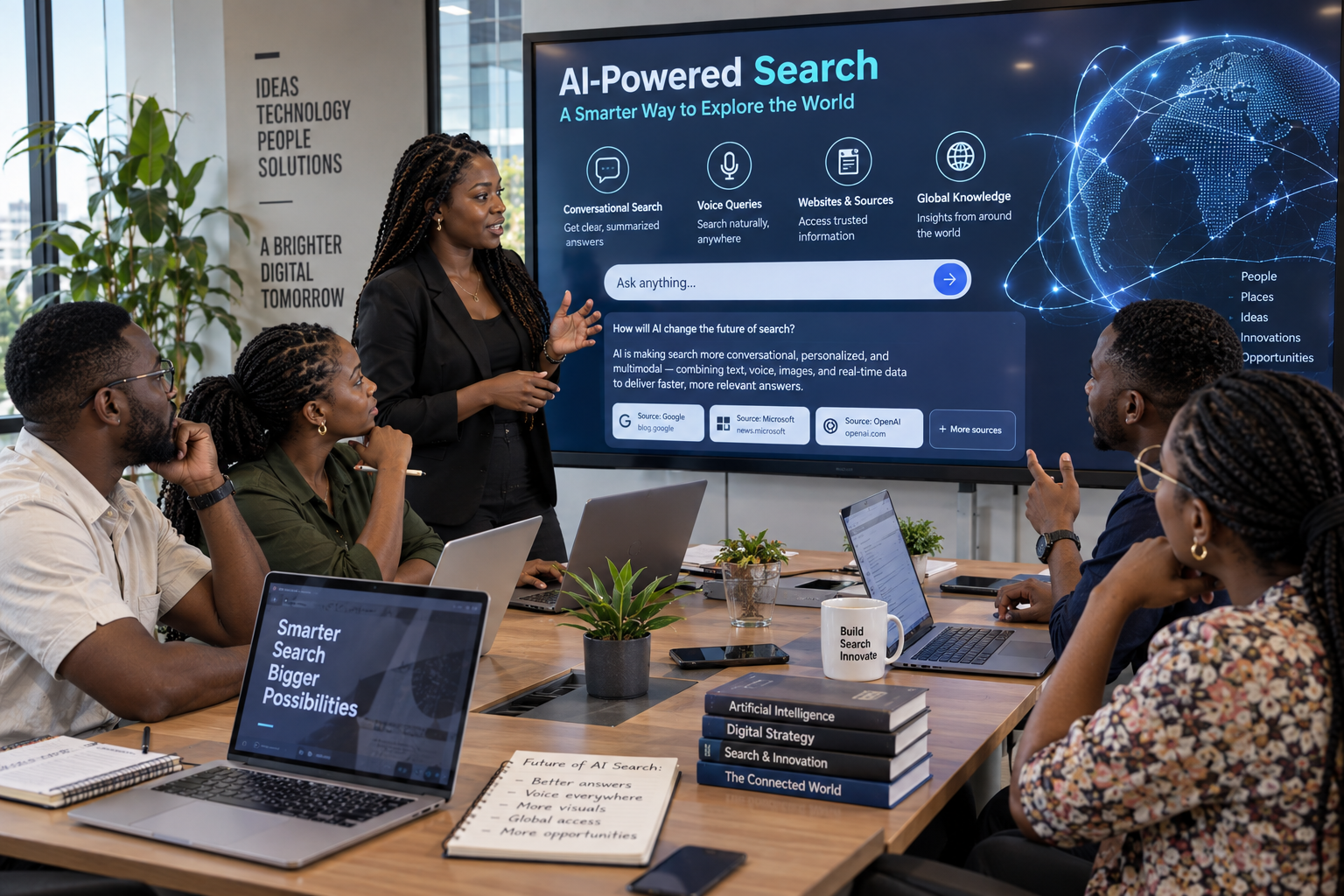
For decades, search engines have helped people find information by matching their questions with relevant webpages. A person would type a few keywords, review a list of links, and visit the websites that appeared most useful.
Artificial intelligence is now changing that experience.
AI-powered search can understand questions in a more conversational way, interpret context, summarize information, and help users explore topics through follow-up questions. Instead of simply providing a list of webpages, modern search experiences can increasingly help users understand information directly.
This shift is changing how people search, how businesses create content, and how websites compete for visibility online.
1. What Is AI Search?
AI search refers to search experiences that use artificial intelligence to understand queries and provide more context-aware results.
Traditional search largely relies on matching a user’s query with information contained on webpages. AI can go further by interpreting the meaning and intent behind a question.
For example, instead of searching:
“best laptop students”
a user might ask:
“What should I look for when buying a laptop for a university student studying computer science?”
An AI-powered search system can interpret the broader context and provide a more conversational response.
2. Search Is Becoming More Conversational
One of the biggest changes brought by AI search is the shift from keywords toward natural language.
People no longer have to think like search engines when asking questions.
They can type or speak complete questions such as:
- “What is the easiest way to learn digital marketing?”
- “Why is my website loading slowly?”
- “What should I pack for a business trip to London?”
- “Compare these two smartphones for photography.”
AI systems are designed to interpret natural language, making search feel more like a conversation.

3. Searchers Can Ask Follow-Up Questions
Traditional search often required users to start a new search whenever they wanted additional information.
AI search can maintain context across multiple questions.
For example:
User: “What are the benefits of remote work?”
Follow-up: “What are the disadvantages?”
Follow-up: “How can a small company make it work?”
The system can use the context of the conversation to provide increasingly specific answers.
This makes information discovery more interactive.
4. AI Can Summarize Information
Another major development is the ability of AI systems to summarize information from multiple sources.
Instead of opening several webpages and reading each one individually, users may receive a condensed explanation that helps them understand the main points.
This can be particularly useful when researching:
- Products
- Business topics
- Academic subjects
- Current events
- Technical concepts
- Travel information
- General questions
However, users should still verify important information against reliable sources because AI-generated summaries can contain errors or missing context.
5. Search Intent Is Becoming More Important
AI search makes search intent increasingly important for businesses and content creators.
Search intent refers to what a person is actually trying to accomplish when they search.
For example, someone searching for:
“digital marketing”
could be looking for a definition.
Someone searching:
“digital marketing agency in Lagos”
may be looking for a service provider.
Someone searching:
“how to create a digital marketing strategy”
is probably looking for educational information.
Understanding these different intentions helps businesses create content that actually answers people’s needs.
6. Long-Tail Questions Are Becoming More Valuable
AI search makes it easier for people to ask detailed questions.
This increases the importance of long-tail queries.
Instead of searching for:
“SEO”
a user might ask:
“How can a small business improve its Google visibility without spending a large advertising budget?”
Content that directly addresses specific questions can therefore become more useful in AI-driven search environments.
Businesses should focus not only on individual keywords but also on the questions, problems, and topics their audiences care about.
7. Content Quality Matters More Than Keyword Stuffing
AI-powered search reinforces an important principle in modern SEO: content should be useful to people rather than written simply to manipulate search rankings.
Poor-quality content may contain keywords repeatedly without providing meaningful information.
High-quality content typically:
- Answers the reader’s question.
- Provides useful context.
- Uses clear language.
- Demonstrates expertise.
- Includes relevant examples.
- Links to trustworthy sources.
- Avoids unnecessary repetition.
Businesses should focus on creating content that genuinely helps their target audience.

8. AI Search Is Changing SEO
Search engine optimization is evolving alongside AI.
SEO is no longer simply about choosing a keyword and placing it repeatedly throughout an article.
Modern SEO involves understanding:
- Search intent
- Topic relevance
- Content quality
- Website experience
- Authority
- Structured information
- Internal linking
- Technical performance
- User needs
Businesses also need to consider how their content can be discovered, understood, and referenced within AI-powered search experiences.
9. Websites Still Matter
The growth of AI search does not mean websites are becoming irrelevant.
AI systems still need information to answer many questions, and original websites remain important sources of information.
For businesses, this makes it important to maintain a strong digital presence.
A website should provide:
- Accurate information
- Clear service descriptions
- Helpful educational content
- Updated business information
- Strong technical performance
- Easy navigation
- Clear contact information
A business cannot assume that an AI system will create its online presence for it.
10. Original Content Can Become a Competitive Advantage
As AI makes it easier to generate generic content, original information becomes increasingly valuable.
Businesses can differentiate themselves by publishing information based on:
- Original research
- Customer experiences
- Expert opinions
- Case studies
- Industry data
- Interviews
- First-hand observations
- Unique examples
For example, a digital marketing agency could publish a case study explaining how a particular campaign performed rather than publishing another generic article about “10 digital marketing tips.”
Originality can make content more useful and memorable.
11. Local Search Is Also Changing
AI can make local search more conversational.
Instead of searching for:
“restaurants Lagos”
someone might ask:
“Where can I find a quiet restaurant in Lagos suitable for a business meeting?”
This means businesses need to provide detailed and accurate information about what they offer.
Local businesses should pay attention to:
- Business descriptions
- Locations
- Opening hours
- Services
- Reviews
- Website information
- Local search profiles
The more accurate and useful the available information, the easier it can be for search systems to understand the business.
12. Voice Search and AI Search Are Connected
AI is also contributing to the growth of conversational and voice-based search.
Speaking a question naturally is often easier than constructing a short keyword query.
For example, a person might say:
“How do I create a landing page that converts visitors into customers?”
rather than typing:
“landing page conversion tips.”
Businesses should therefore consider the natural questions customers might ask about their products and services.
Creating content around those questions can help address both traditional and conversational search behavior.
13. People Are Becoming More Comfortable Asking Complex Questions
AI search allows users to explore topics that would previously require multiple searches.
A user can ask for explanations, comparisons, examples, summaries, and follow-up recommendations in a single conversation.
This changes the role of search from simply finding information to exploring information.
The user may begin with a broad question and gradually narrow the topic based on what they learn.
This can make research faster and more personalized.

14. Businesses Need to Think Beyond Ranking Number One
For many years, businesses focused heavily on achieving the first position on search engine results pages.
AI search introduces a broader challenge.
A business now needs to make its information useful enough to be discovered, understood, trusted, and potentially referenced by search systems.
This means companies should think about their entire digital presence rather than focusing exclusively on one ranking position.
A strong strategy combines:
- Useful content
- Technical SEO
- Strong branding
- Expert knowledge
- Positive user experience
- Reliable information
- Consistent digital visibility
15. AI Search Does Not Eliminate the Need for Human Judgment
Despite its advantages, AI search has limitations.
AI systems can sometimes:
- Misinterpret questions.
- Produce incorrect information.
- Combine information incorrectly.
- Miss important context.
- Present outdated information.
- Sound confident when the answer is uncertain.
Users should therefore evaluate important information carefully.
For medical, financial, legal, academic, and other high-stakes topics, reliable primary sources and qualified professionals remain particularly important.
16. How Businesses Can Prepare for AI Search
Businesses do not need to completely abandon traditional SEO to prepare for AI search.
Instead, they should strengthen the fundamentals.
Create useful content
Answer real questions customers ask instead of producing content solely for search engines.
Demonstrate expertise
Share insights, experience, case studies, and original perspectives.
Organize information clearly
Use descriptive headings, concise paragraphs, lists, and logical structures.
Keep information updated
Review important pages regularly and correct outdated information.
Improve website experience
Make websites fast, mobile-friendly, accessible, and easy to navigate.
Build authority
Earn credible mentions, links, reviews, and references from trustworthy sources.
Understand your audience
Research the questions and problems your customers are actually trying to solve.
Conclusion
AI search is changing information discovery from a simple process of finding webpages into a more conversational and interactive experience.
People can ask detailed questions, request explanations, compare options, and continue conversations without repeatedly starting from scratch.
For businesses, this creates both an opportunity and a challenge. Search visibility increasingly depends on providing useful, accurate, well-organized, and trustworthy information.
The fundamentals of good SEO still matter, but the focus is becoming broader: understand what people need, answer their questions clearly, demonstrate genuine expertise, and create a digital presence that deserves to be discovered.
As AI continues to reshape search, the businesses most prepared for the future will be those that focus less on simply attracting clicks and more on becoming genuinely useful sources of information.